
Parenting Guide: The ABCs of an Independent, Autonomous and Self-Esteeming Child
Your child needs to be themselves, not an appendage of yours. Many parents expect a child to adapt to adult life, and very few know how important it is for the adult to adapt to child life. Their independence, autonomy, and self-esteem do not come when they walk with their mother to the mall or hypermarket. Children need their own lives, they need to build their own environment that brings them emotional stability and joy through experiences appropriate to their age. David Elkind, professor of child psychology at Tufts University in Medford, Massachusetts says that "The contemporary pressure on children to grow up faster is a symptom of a modern society that moves at far too high a speed. This extension of speed onto children is unfortunate. Children need to grow, learn, develop at their own pace. Giving them this time is the only way they will grow up to be truly independent and self-assured.".
Every parent embarks on the path of parenting like a bird with its chicks: I need to teach my child to "fly". But how do I do that? How does he become resourceful, in control of his own abilities and values? How do I help him fly safely? Without getting tired, without collapsing, and without depending on me? The ABCs of a child's independence everything starts from the very first months of life, and the three coordinates remain valid for the rest of his childhood, even after he leaves the nest.
A from AFecteau
The first step to being a good parent is to be there, present. And the next step that leads you to being an excellent parent is to love your child. From here everything comes naturally, instinctively and with extraordinary benefits for your child. Because in AFFECTION we include the most important skill that you can stimulate and develop in your child: emotional intelligence. Studies have shown that this type of intelligence is more important than cognitive intelligence in the child's success as an adult.
The term was first used in 1990 by psychologist Peter Salovey of Harvard University and John Mayer of the University of New Hampshire, when they created a list of those qualities that a child must develop to have a high EQ (emotional quotient):
- empathy
- expressing and understanding emotions
- controlling temper
- independence
- adaptability
- charisma
- problem-solving ability
- persistence
- friendliness
- kindness
- respect
What is the most important difference between emotional and cognitive intelligence? That the former can be shaped and developed by parents more than the latter, which is mostly genetically inherited. Therefore, dear parents, you have a great opportunity here to support your child's emotional development by checking the coordinates above, which all come, develop and exist from the affection we have for our child.
Aquatic education starting from 3-4 months of age is an effective way to support the development of a child's emotional intelligence, ticking all the above points. Empathy, respect, friendly attitude, charisma, kindness are important social skills that the little one will develop with the help of ABC instructors. Expressing and understanding emotions, controlling temper, independence, adaptability, persistence, the ability to solve problems, all will be results of constant aquatic education, of the exercises that ABC instructors use at each aquatic education session to train not only a healthy body but also a bold, insightful and autonomous mind.
B is for JOY
We need to understand something very important: if our joy as adults can be defined by the absence of problems, that of children is a little different. Children love problems, they love to be put in situations that stimulate their problem-solving abilities. It is enough to watch a group of 2-3 year olds building a sandcastle on the beach to see how much joy they get not only from the construction, but also from the waves that constantly destroy the castle wall. Children need to be allowed to solve their own problems, to find their own solutions, because this not only brings them autonomy and self-esteem, but also joy.
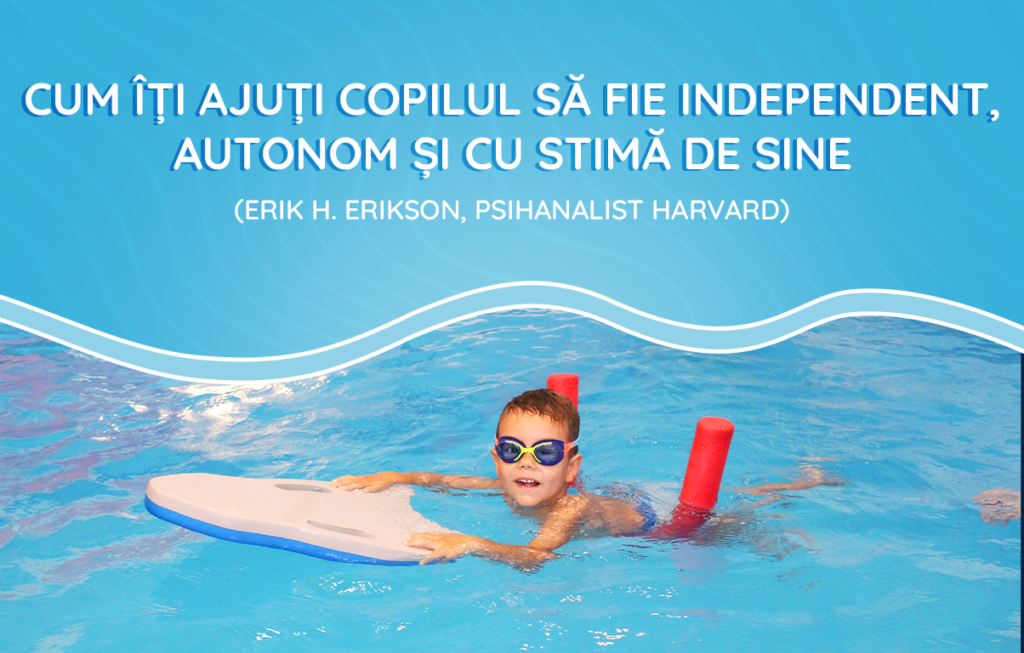
Psychologist Martin Seligman says that the greatest joy we can give our children is to give them the opportunity to master their own environment. Every time we take our child swimming, for example, and let them develop their motor skills in an environment they can easily master (as opposed to dry land) from a few months old, we give them the joy of discovering that they are capable of doing things on their own. They discover that certain actions can have predictable results and that the road to success is paved with determination and perseverance, and success through their own strength gives them the most valuable skill for adult life: self-esteem.
Therefore, as Stephanie Thornton, a professor of psychology, says in her book Children Solving Problem, A happy and emotionally intelligent child depends more on the experience we give them than on how intelligent they are. And aquatic education is one of the most complex such experiences, where the joy of childhood combines excellently with new and new ways of developing emotional intelligence.

C is for COMMUNICATION
David Elkind, in The Hurried Child, emphasizes how important it is how we communicate with our child. We must give him respect as we would like from him and other family members. Saying "please" and "thank you" is the foundation of a high self-esteem. Because of all the skills that belong to emotional intelligence, the most important in his success as an adult is that of socialization, communication, the way he manages to handle himself in various social situations. And we can observe this even in nursery or kindergarten, we can see how cheerful, sociable children receive more attention and make friends much more easily, how they have less or no anxieties and are able to adapt more easily in a new environment.
Fortunately, social skills can be taught and trained. For example, many babies are afraid of strangers and/or have separation anxiety. At Acvatic Bebe Club, through a safe, predictable, playful environment, we train the social skills of the little adventurer in the aquatic world. One of the methods is to change the instructor, so that the child gets rid of or does not develop fears for unforeseen social situations and can accommodate from the first months with anxiety separation from parents, which is inevitable and stimulating for his autonomy. Together we help your baby learn that if he doesn't see you, if you don't hold him in your arms, it doesn't mean he's abandoned. Separation from parents is part of his life and it is a situation that must be experienced, so that a child can gain the self-esteem he needs to become a successful adult.
And the most important thing in communication is to be honest with your child, especially as he grows up. Don't hide, don't run away, don't lie to him, even if you know that the truth will bring him emotional discomfort. It is very important that your child trusts you. It is okay to tell him that I am leaving, but I will be back. Don't dramatize. Don't promise what you can't fulfill. Be honest.
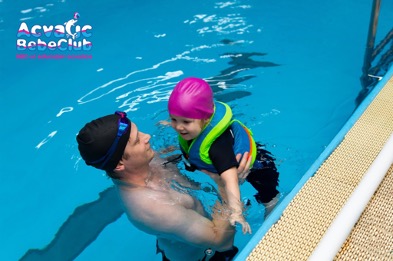
At ABC, your child's pace matters
Dr. Pikler writes in Peaceful Babies—Happy Mothers, that, a baby, without our intervention, will learn to roll over, to crawl, to walk on its own. And this will not happen under pressure, but on its own initiative, independently, with joy and pride when it succeeds, even if it will sometimes cry in frustration until it reaches the desired result. If you want an independent, autonomous child, the little one must discover who he is on his own, experiencing life and his adventures in his own way.
That's why at Acvatic Bebe Club we don't force children to do things they're not ready for yet. We've learned that we need to observe the child, their personality, and not put them on a time table with skills that must be ticked off. We've learned to let the child be themselves, to fight, to make mistakes, to hesitate, to get scared, to try, to succeed, to enjoy, to play. The child is not a ticking board: today they learn to catch a ball, tomorrow to walk, and the day after that to swim. We've learned to respect each child by adjusting our aquatic education technique to their way of being and learning, to give them the opportunity to prove their competence on their own, without being forced or pushed from behind. Let's focus on HOW and WHAT, not WHEN. Because we know that's how we increase their self-esteem. It is not important when the child will learn to swim, but how and what he learned from aquatic education lessons. Children in the water are miraculous, they learn to trust their body and mind, to overcome their fears, to solve problems, to persevere, to communicate, to taste the joy of success and to be stimulated by failures. Because we know that a child who is supported and taught that he has the freedom to choose will also learn to make the right choices. And that is what we want for our children, right?
Bibliography:
- https://ro.scribd.com/book/237250787/Swimming-For-Babies
- https://ro.scribd.com/book/336809563/The-Everything-Parent-s-Guide-to-Emotional-Intelligence-in-Children-How-to-Raise-Children-Who-Are-Caring-Resilient-and-Emotionally-Strong
- https://ro.scribd.com/audiobook/440433733/The-New-Basics-A-to-Z-Baby-Child-Care-for-the-Modern-Parent
- https://ro.scribd.com/book/264130657/Your-Self-Confident-Baby-How-to-Encourage-Your-Child-s-Natural-Abilities-From-the-Very-Start
- https://ro.scribd.com/book/380997492/Emotional-Intelligence-for-Children-A-Parent-s-Guide-to-Raising-an-Emotionally-Intelligent-Child