What's in pool water and baby's skin: what parents need to know
Dr. Mihaela Niță – Pediatrician Specialist
Baby skin is one of the most sensitive organs during the first few months of life. It is not just a protective barrier, but also an active organ involved in temperature regulation and interaction with the environment.
And, paradoxically, it is also one of the most exposed when we talk about aquatic activities, where contact with water is prolonged and repeated.
A baby's skin isn't „like ours,” adult skin
Compared to an adult:
- it's thinner
- has an incompletely matured skin barrier
- loses water more easily
- loses heat more easily
- allows for increased absorption of substances from the environment.
These physiological particularities make a baby's skin much more vulnerable to external factors.
This means that any repeated contact with chemically treated water counts, even if no obvious reactions appear at first glance.
Chlorine and its derivatives – what we need to understand
Chlorine is frequently used for water disinfection and plays an essential role in preventing infections. It is undoubtedly effective, but it is not entirely without side effects:
- can irritate the skin and eyes
- can affect the balance of the skin microbiome
- in combination with organic matter → forms irritating compounds.
In high-traffic swimming pools, these compounds can be present in varying concentrations, depending on the biological loading of the water.
In adults, these effects are most often minimal or go unnoticed.
However, in a baby, they can become clinically relevant precisely because of the increased sensitivity.
What do we see in practice
Parents can observe:
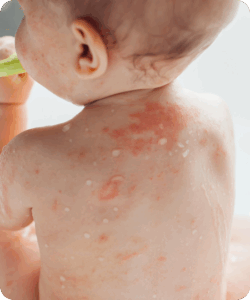
- Dry or irritated skin after repeated exposure
- rash
- red eyes or tearing
- Discomfort during or after activity.
Sometimes these manifestations are subtle and can be attributed to other factors. Other times, they become obvious and raise questions.
The important thing is that they are frequent enough to warrant our attention and to prompt us to analyze the environment to which the child is exposed.
What can parents do
A few simple measures can make a real difference:
- choose dedicated environments with controlled traffic
- to respect hygiene before and after entering the water
- to observe the child's skin reaction
- avoid exposure if there are active skin lesions or irritation.
It's not about avoiding water, but about choosing a suitable context.
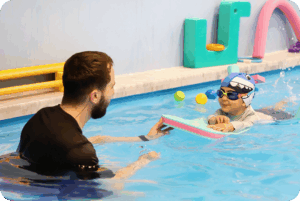
The role of a well-constructed concept
In a properly organized environment:
- The water parameters are stable
- exposure is controlled
- Risks are anticipated, not treated afterward.
The real difference isn't always visible on the surface, but it's reflected in how the child tolerates and enjoys the experience.
Acvatic Bebe Club operates on this principle: prevention is part of the design, not a reaction to problems.
Conclusion

Water can be an excellent environment for baby development, offering motor, sensory, and emotional benefits.
But for babies' skin, water quality makes the difference between a beneficial and a harmful experience.which can cause discomfort.
And this difference begins with an informed choice.