Autism and the benefits of swimming in babies
Childhood autism or autism in children is a condition that cannot be easily perceived with the naked eye. It generally begins before the age of 3 and begins to affect the daily lives of little ones. However, you should not panic! This should not be seen as a dead end. Currently, studies and research are being conducted to discover solutions to help babies lead a better life. What does this have to do with swimming in babies? We will tell you briefly in this article.
When you say "benefits" and add "swimming for babies" next to it, your brain automatically recognizes a truism. In the case of babies, the benefits of swimming are extraordinary, because aquatic movement, coordinated by the skills of an instructor from a very young age, is a gift that our little ones can use throughout their lives. And we're not saying it, specialists are saying it, from pediatricians to researchers, who, following their studies and experience with the health of little ones, have discovered that aquatic education brings a long and important series of benefits to the physical and mental health of children, even from 2-3 months old.
Aquatic education is more than just fun and simple movement in the water. In the case of babies, we are not just talking about swimming, we are talking about a discipline, with gradual methods, personalized to the needs of the little one, with the help of a specialized instructor, so that the little swimmer develops in a balanced way through the many benefits of this activity. Let's see what they are:
- Intelligence and swimming in babies
- Autism and swimming in babies
Baby swimming and intelligence
The earlier you start swimming, the smarter you will be. No, it's not a quote from Cicero or Plato. It's a scientific truth proven by researchers at the German Sports College. They studied two control groups, a group of babies who received aquatic education for 1 year from the age of 2-3 months and another who did not. When the little ones reached around 3 years old, they were tested. The results were like the ones above, showing that the first group has a more balanced motor ability than the second group. But the German tests also revealed that the first group of children had a much better score on intelligence and problem-solving tests, also demonstrating a superior development of emotional intelligence, with stronger self-control, a greater desire for successful results and much more developed social skills.
How is this explained? Well, early learning is stimulated by reflexes that translate into movement exploration. When this exploration is repeated, new complex neural pathways are created, which lead to superior cognitive development. The more complex, more diverse the aquatic movements, the stronger the brain stimulation, thus leading to a higher IQ of the child. This fact was also demonstrated by researchers at Griffith University in Australia in 2009, with a study complex on 45 swimming schools in Australia, New Zealand and the USA, which included 7000 children.
Autism and swimming in babies
IN A study led by Dr. Liselott Diem, it was shown that babies who participated in swimming lessons from the age of 2 months to 4 years were much better adapted to new social situations, having much more self-confidence, associated with autonomy and the ability to cooperate more easily in a social structure. This was the first study to analyze the benefits of swimming on children outside the area of physical development, more than 45 years ago. But it sparked interest in aquatic activities for babies, leading to modern studies that revealed that the social development part of this sport helps children with childhood autismFor example, a study of National Kaohsiung University in Taiwan but also a POLL of the Department of Occupational Therapy at the University of Kansas Medical School have revealed the positive benefits in the therapy of children with autism, especially in terms of social skills. Why? Because aquatic education lessons conducted according to the child's needs build confidence in the child's own strengths, trust in the instructor through socialization, and the routine becomes the balance that a child needs, not only those with autism, being stimulating through the diversity of exercises.
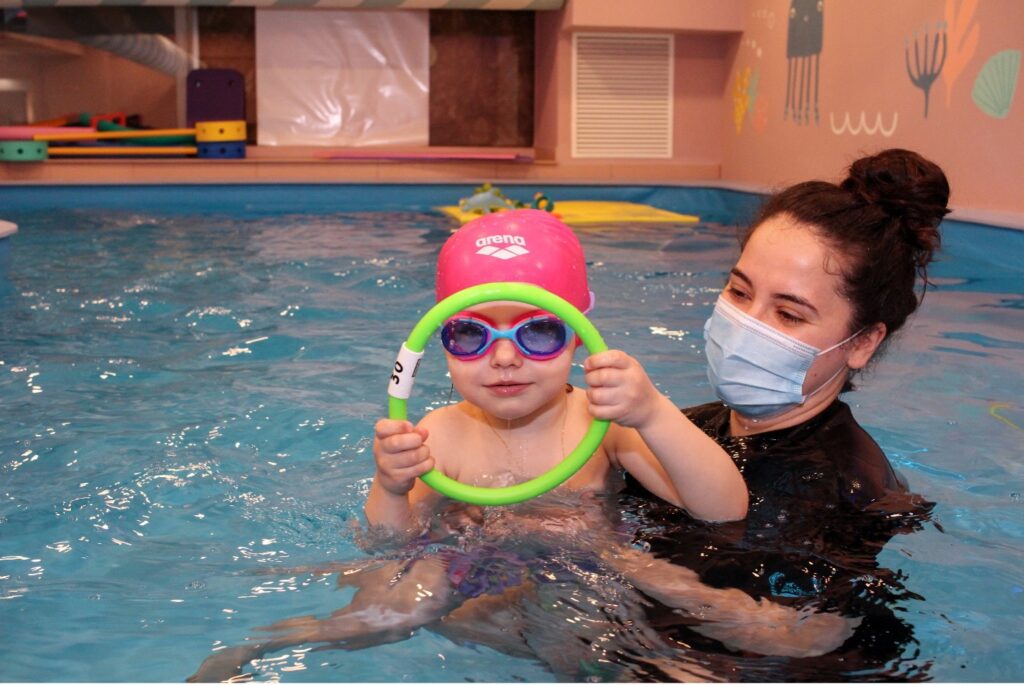
We cannot conclude without emphasizing that the well-being induced by aquatic education transcends all the above benefits with major health benefits, at a much more detailed level, through supported studies, which, even if they were conducted on children or not, are extremely relevant, such as cardiovascular health, release of endorphins which bring well-being, respiratory health, bone and cartilage health with particular effect on bone density.
Therefore, whether you want your child to become an Olympian or to acquire a skill that will give them joy and can save their life, swimming is, without a doubt, the form of exercise that brings them the most benefits on their physical and emotional health. The effect of aquatic education is all the stronger and lasts longer the more the child begins the routine of this sport at a younger age. And you as a parent, in addition to the fact that you will pat yourself on the back and praise yourself for a truly beneficial decision for your child, you will rejoice at the thought that in years and years your child, as an adult, will enjoy enviable health and will say to himself: "It's a good thing my parents took me swimming when I was little."
Bibliography
- Blauw-Hospers, CH, Hadders-Algra, M. (2005) A systematic review of the effects of early intervention on motor development. Developmental Medicine & Child Neurology, 47, 421–432.
- Hopkins, B., Westra, T. (1988) Maternal handling and motor development: An intracultural study. Genetic Social and General Psychology Monographs, 114, 377–408.
- Langendorfer, SJ, Bruya, LD (1995) Aquatic readiness: Developing water competence in young children. Champaign, IL: Human Kinetics.
- Sigmundsson, H. and B. Hopkins. 2010. Baby swimming: exploring the effects of early intervention on subsequent motor abilities, Child: Care Health and Development. 36:3, 428-430. DOI: 10.1111/j.1365-2214.2009.00990.x
- Brenner RA Gitanjali ST, Haynie DL, Trumble AC, Qian C., Klinger RM, Klebanoff MA, Association Between Swimming Lessons and Drowning in Childhood: A case control study. Archives of Pediatrics and Adolescent Medicine 2009; 163(3):203-210
- Zelazo PR, Weiss MJ, "Infant Swimming Behaviors: Cognitive Control and Influence of Experience." Journal of Cognitive Development 7 (1); 2006: pp. 1-25

