Hydrokinesiotherapy and its role in the healthy development of premature babies
The skin is the largest organ in the body and with its eleven cutaneous receptors, it represents a constant source of stimuli for the central nervous system. Which transforms the tactile or kinesthetic system into the second most important communication system of the human body with the external environment, after that of vision. Thus, we understand kinesthesia as representing all the emotions and internal and external sensations that we perceive using the sense of touch. Based on this communication system, kinesthetic therapy was developed, which has the role of optimizing brain functioning, by creating new connections between neurons, stimulating the growth of synapses through the close connection that the skin has with the functioning of muscles, fascia, ligaments and bones.
Babies born prematurely often have an underdeveloped and underregulated sense of touch. And this is where kinesthetic therapy combined with aquatic therapy comes in = hydrokinesiotherapy, an impressive duo in terms of healthy development of premature babies. These two support each other and shape an impressive journey for the little ones, offering benefits such as:
- Regulation of muscle tension and bone posture;
- Developing and balancing tactile perception;
- Activation and development of sensory-motor integration mechanisms;
- Growth and maturation of reflexes;
- Opening and developing new brain-body connections for emotional, social and cognitive motor development;
- Improving sleep quality and stimulating weight gain;
- Reducing stress levels, associated with sensory hyperstimulation specific to premature babies;
- Development of lung and heart capacity.
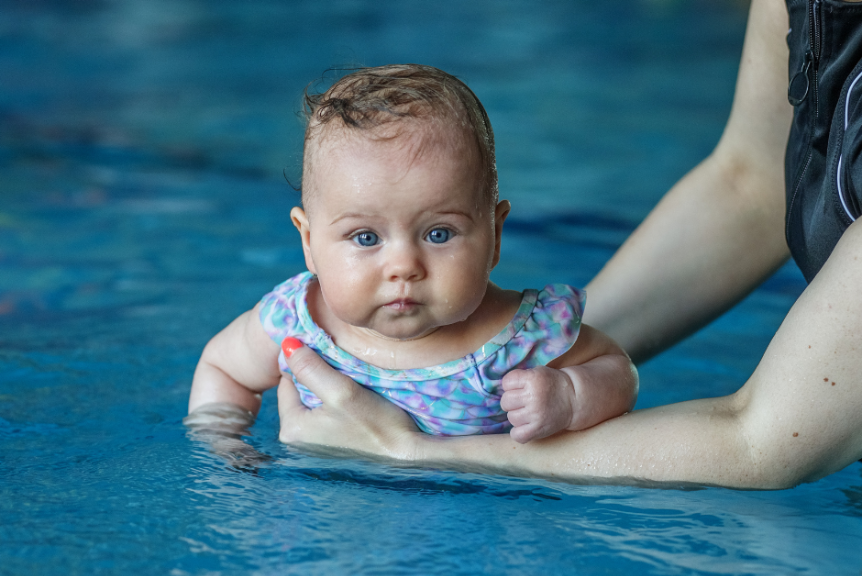
Hydrokinesiotherapy is more than aquatic therapy and more than kinesthetic therapy. It is an effective formula, an ancient medical therapy, that brings both together to support the healthy development of premature babies through aquatic sensory movements. By exploiting the physical properties of water (buoyancy, pressure and temperature) by stimulating the sense of touch of premature babies, hydrokinesiotherapy offers visible results in just a few sessions. At Acvatic Bebe Club, hydrokinesiotherapy becomes an integral part of aquatic education sessions dedicated to premature babies through:
- Psycho-pedagogical materials: perforated mattresses, water sticks, water mirror, specific sensory toys - to build a stimulating and educational learning environment;
- Games and activities: splashing on the face, moving hands and feet, special gripping techniques – to stimulate hand-foot coordination and body awareness, raising self-esteem and developing confidence and autonomy.
Sources:
- Effects of Hydrokinesiotherapy and Conventional Bathing on Physiological Factors That Influence Stress on Preterm Newborns – Mackenzie Schanzlin, Amy Tremback-Ball – Misericordia University, March 2023 – https://www.archives-pmr.org/article/S0003-9993(22)01803-2/pdf
- Short-Term Effects of Hydrokinesiotherapy in Hospitalized Preterm Newborns - Welcy Cassiano de Oliveira Tobinaga, Cirlene de Lima Marinho, Vera Lucia Barros Abelenda, Paula Morisco de Sá Agnaldo José Lopes – State University of Rio de Janeiro, Sept 2016 – https://www.hindawi.com/journals/rerp/2016/9285056/
- Effects of hydrotherapy and tactile-kinesthetic stimulation on weight gain of preterm infants admitted in the Neonatal Intensive Care Unit – Franciane R. dos Anjos, Adriane M. Nakato, Paula Karina Hembecker, Percy Nohama, Ana Lúcia F. Sarquis - Universidad de Tecnológica Federal do Paraná Brazil, March 2022 – Effects of hydrotherapy and tactile-kinesthetic stimulation on weight gain of preterm infants admitted in the Neonatal Intensive Care Unit – ScienceDirect