How quickly does a baby learn to swim - Informative guide for parents
Every baby is unique. Your baby is unique. So unique, different, exceptional will be his path in life. The same idea is followed in aquatic education, because every baby begins his experience with water differently, as a space, as a time and as a sensory stimulus. And from this point of view, there will never be a comparison. Because the most important mission that you have, as a parent, is to give him an important chance: that of accommodating, of feeling and becoming one with the water, of receiving all the benefits of this wonderful sport in a safe environment and without comparing him to other babies.
Okay, okay, you might say, but how do I know this sport is safe? How do I know my baby will actually learn something? And especially how much patience should I arm myself with?
The swimming reflex
First, you need to know exactly what your little one's developmental stages are, to better understand how aquatic education helps them, even from just a few months. If in the first month the baby is more concerned with sleeping and eating and has a predominantly reflexive behavior, you should know that he was already born with a reflex that he will lose around 4-6 months: the swimming reflex. It is an archaic instinct that helps him survive in case he falls into the water. Of course, this will not happen, because you are a responsible parent, but it is precisely this reflex that must be speculated.
So from 2 months onwards we must take advantage of it, of the primary instinct of survival in the water. Because the baby has already become active, his motor cortex matures, unnecessary reflexes disappear, he responds to all stimuli and, most importantly, he has the necessary motility to start aquatic education. This, plus the swimming reflex that he has not lost, makes him the perfect candidate to step into the aquatic world, now, before he starts to develop fears, anxieties and tantrums. Now the baby starts to develop, above all, fundamental confidence, the feeling of the capacity for action and the coherence of his own being and exercises learning capacities. Now is the time.
Of course, it is not mandatory for babies to start aquatic education at 2-3 months, we only tell you what specialists recommend as a result of the way in which it develops cognitively. The recommendation also comes as an addition to the fact that our little ones have no idea what fear is until 8-9 months, even 1 year. Some are even braver and discover this emotion only at around 2 years old. The lack of the instinct of conservation that we adults strongly perceive is a strong point in aquatic education, precisely because water is not perceived as a threat by little swimmers, but rather as a friendly, comfortable, intimate environment, associated with intrauterine life. Attention, we are talking about aquatic education here, not about a child left on the edge of a pool unattended. Only in the first case is the lack of fear an advantage. In the second case, aquatic education is the biggest advantage and you will immediately see why.
The ABCs of Aquatic Education
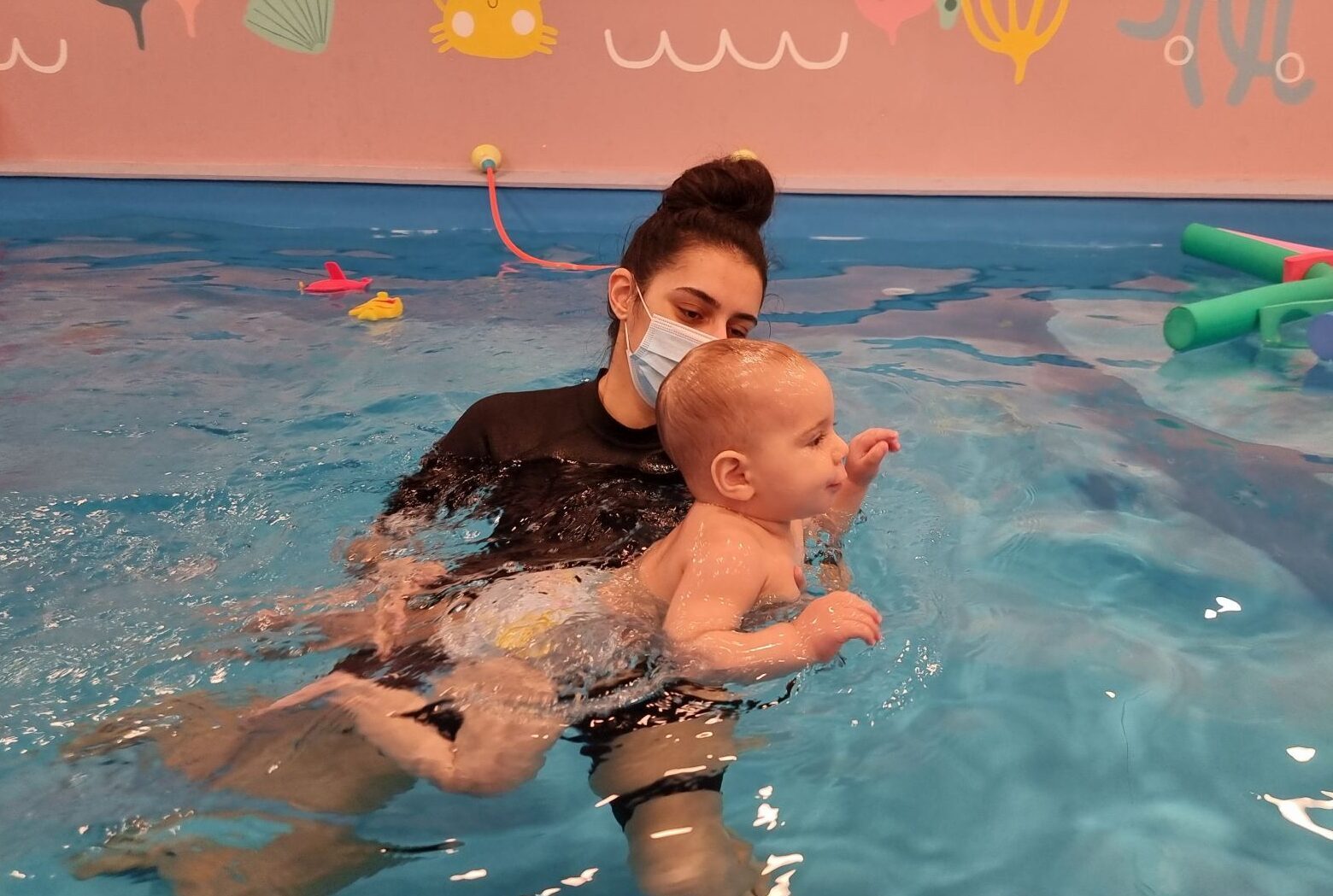
This is where your baby's adventure at Acvatic Bebe Club begins. And you need to know it, in order to fully understand the answer to the question in the title of this article. We call it ABC because it is exactly like an ABC book of swimming, where:
- A comes from Accommodation and Acclimatization, a first step where the little one acclimatizes to the aquatic environment, discovers the joy of weightlessness in the water and freedom of movement, permanently supported by the best instructors, in a safe and hygienic environment. Practically, this step is the one that any athlete does before training, the "warm-up" step, and is always present at the beginning of an aquatic session, even for babies.
- B comes from BENEFITS, not only because after just a few sessions they will be visible to the naked eye, true BENEFITS on his health, both physical and mental, even for children with special needs: from obvious motor skills and flexibility, to permanently supported muscle development, to immunity increased and to the evolution of independence, autonomy and social skills, but also because our B comes from something else, from GentlenessEach session will take place under the auspices of a method focused on his needs, without haste and in direct synergy with his speed of development, with exercises adapted to his age and personality.
- C comes from Communication and not just any kind of communication, but a positive one, based on encouragement, support, trust and lots of affection. The instructor is attentive to what your little one is communicating and adapts the exercises so that at the end of the session, fatigue and irritability do not set in, but good mood and cheerfulness.
And now let's find out the answer to the question "How quickly will my baby learn to swim?"
We have a suspicion that you already guessed the answer: your baby will learn to swim as quickly as he wants. Not as fast as you want, nor as fast as dad, grandma, aunt or his instructor wants. There are babies who at 1 year old are already experts in diving, but they don't want to jump. Or babies who jump into the water without fear, dive skillfully, but have not yet acquired the ability to swim on the surface of the water. What is important? That everything is a game, not an obstacle course, not a competition, not a reason for praise, not a physical and mental effort that exhausts him and ends up perceiving this activity as something it is not: a burden.
The important thing is to be patient, to support him and to perceive aquatic education not only as a simple skill that your child acquires, but as a long-term training for a healthy life as an adult. Because the benefits of this complex sport are extraordinary and a priceless gift that you give. Each movement in the water provides a complete exercise for the muscles, lungs, heart and, most importantly, the brain, simultaneously stimulating all 5 pillars of the senses: smell, sight, hearing, taste and touch. Water is relaxation, play, therapy, health, ritual, food and energy. And this is what your baby must and will feel with us. For him, aquatic education will become a routine that will balance him and form elementary qualities for adult life.
Celebrate every step of his journey and remember that rushing is not the answer, that there will be periods of assimilation and learning plateaus, and that swimming is not learned overnight because it is more than a skill, it is exploration, curiosity, confidence, joy, inquisitiveness, independence, grace, and resilience. It is his future.
Bibliography:
- Baby Swimming – Author: Lilli Ahrendt – Meyer & Meyer Sport Publishing, 2021
- Swimming For Babies – Author: Albert Gundani, 2014
- Learn to Swim: Helping Parents to Teach Their Baby to Swim – Newborn to 3 Years, Authors: Tracey Ayton and Ben Holden, Meyer & Meyer Sport Publishers, 2019
- Learn to Swim Step-by-step water confidence and safety skills for babies and young children – Authors: Rob and Kathy McKay, DK Publishing, 2005
- United States Swim School Association – www.usswimschools.org
- World Aquatic Babies Congress – www.waterbabies.org

